
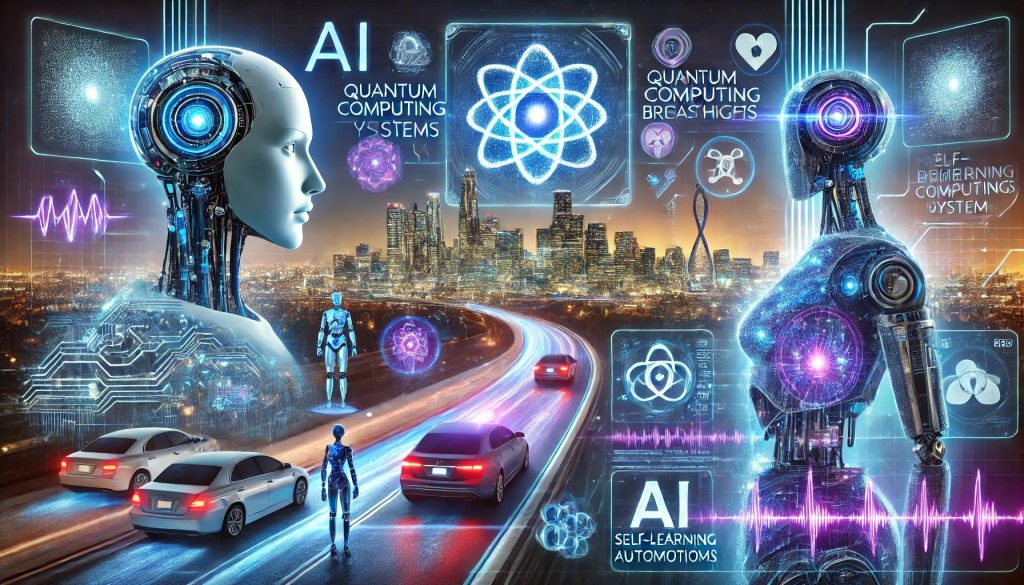
The Intersection of AI, Computing, and Science: How Technology Is Accelerating Discoveries in 2025
Today’s whole world is about the digital world, or known as a combination of science, AI, and Computing. These three things are making the world digitalized, which is also beneficial for humans and for their future.
The world of science is evolving at a pace never seen before — and the biggest force behind this transformation is the powerful combination of Artificial Intelligence (AI) and advanced computing. In 2025, these technologies are not just helping scientists — they are reshaping how scientific discoveries happen, making complex research faster, more accurate, and more innovative.
This intersection of AI, computing, and science is opening doors to breakthroughs in medicine, climate research, space exploration, physics, and many more fields. Here’s how this powerful trio is changing the world.
1. AI Is Becoming a Research Partner for Scientists
AI is no longer just a tool — it is becoming a research assistant capable of analyzing massive datasets, predicting outcomes, and helping scientists make sense of information that would take decades to study manually.
Where AI is helping today:
Genomics: AI can read and analyze DNA patterns in seconds.
Drug discovery: Instead of years of trial and error, AI can predict which molecules may become effective medicines.
Environmental science: AI models help analyze climate patterns, predict floods, heatwaves, and weather events.
Astronomy: AI scans millions of space images to discover new stars, black holes, and galaxies.
AI is helping science move from slow discovery cycles to rapid breakthroughs.
2. High-Performance Computing (HPC) Accelerates Complex Simulations
Advanced computing systems — including supercomputers and quantum computers — now support scientific research at a scale not possible before.
HPC enables:
Faster chemical simulations used in new drug creation
Climate modeling for understanding global warming
Simulations of black holes, galaxies, and space-time
Physics calculations like particle behavior
Earthquake and natural disaster predictions
These simulations help scientists run thousands of model scenarios in hours rather than years, leading to more accurate predictions and better scientific understanding.
3. AI + Computing in Medicine: Faster Treatments & Better Diagnosis
Healthcare is one of the biggest beneficiaries of AI-driven science.
Breakthroughs happening now:
AI scanning systems detect diseases like cancer earlier than human doctors.
Smart wearables track heart rate, oxygen levels, sleep, and overall health 24/7.
AI-powered personalized medicine tailors treatments based on an individual’s unique genetic profile.
With computing power increasing, medical models can now check billions of medical records to find patterns and cures faster than ever.
4. Space Science Powered by AI
Astronomy uses huge amounts of data — far too much for humans to analyze alone. AI fills that gap.
How AI helps in space research:
Identifies exoplanets (planets outside our solar system)
Helps guide space telescopes
Processes images from Mars rovers
Predicts asteroid paths and space threats
Helps design better spacecraft materials
Space missions now rely heavily on AI-based navigation, automation, and analysis.
5. Climate Science Transformed by AI Models
Climate scientists rely on massive data: ocean temperatures, atmospheric changes, wind movement, ice patterns, and more. AI models process this data to:
Predict extreme weather
Model long-term climate change
Track environmental damage
Identify natural disaster risks
AI is helping governments and scientists plan better responses to floods, earthquakes, droughts, and storms.
6. Quantum Computing: The Next Scientific Frontier
Quantum computers — far more powerful than traditional computers — are still emerging but already influencing science.
Quantum computing helps with:
Complex molecular modeling
Advanced physics calculations
Super-fast climate simulations
Optimizing energy systems, transportation, and logistics
When quantum computing matures, it may unlock new scientific laws and discoveries.
7. Discoveries Are Happening Faster Than Ever Before
In the past, scientific discovery took years or decades. But with AI and computing:
Experiments are simulated instead of built
Data is analyzed instantly
Models predict outcomes before research begins
This reduces costs, speeds up innovation, and increases accuracy — helping humanity progress faster.
8. Challenges and Ethical Considerations
With great power comes responsibility. As AI becomes more involved in science, there are important concerns:
Ensuring AI predictions are accurate and unbiased
Protecting sensitive medical or climate data
Keeping scientific research transparent and ethical
Preventing misuse of powerful technologies
Scientists and policymakers must work together to ensure the safe use of AI in global research.
my point about The Intersection of AI, Computing, and Science: How Technology Is Accelerating Discoveries in 2025
The Future of Science Is Powered by Intelligence — Human and Artificial
The intersection of AI, computing, and science is not just a trend — it is the foundation of future discovery. This powerful combination is giving humanity the tools to solve problems that once seemed impossible: curing diseases, protecting the planet, exploring space, and understanding the universe. This powerful combination is only beneficial for humans because we are living in this world.